A decline in machine performance is rarely caused by a single failure. In most cases it results from the accumulation of multiple micro-issues, such as:
- increased clearances
- uncontrolled vibrations
- uneven load distribution
- deteriorating positioning repeatability
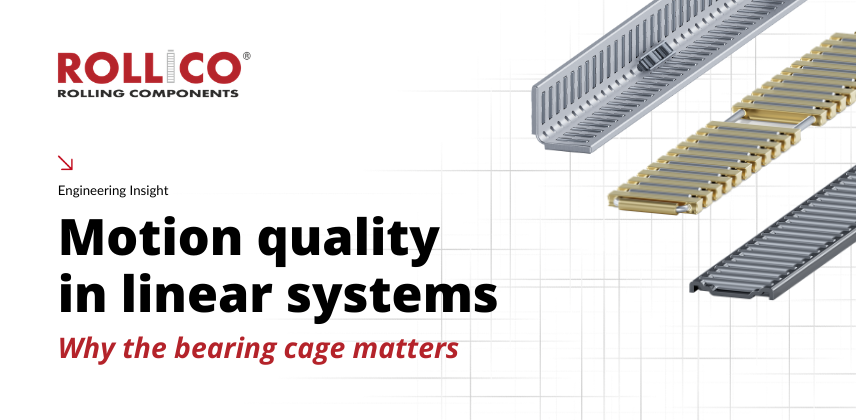
In many machine designs, the root cause of these problems does not lie in the drive system or control architecture, but rather in the underestimated role of guiding components — particularly the bearing cages cooperating with linear guides.
What does “motion quality” mean in practice?
Motion quality is not only about smoothness. It is defined by a set of measurable parameters, including:
- system stiffness [N/µm]
- axial and radial clearance
- vibration damping capability
- load distribution uniformity
- stability of preload retention (through stabilization of rolling element motion by the cage body)
When can motion be considered high quality?
High-quality motion can be observed when the system demonstrates:
- consistent linear guide geometry under dynamic loading
- absence of additional self-excited vibrations generated by the system
- stable preload throughout the entire operating cycle
- maintained positioning repeatability within the specified tolerance
Failure to meet any of these conditions results in real operational costs.
Why the bearing cage plays such a critical structural role
The bearing cage:
- separates rolling elements
- stabilizes their motion
- influences load distribution
- reduces internal friction
An improperly designed or selected bearing cage leads to:
- irregular load transfer
- increased vibration levels, especially at high speeds
- localized overload of rolling elements
- accelerated wear of linear guide raceways
As a consequence, the calculated service life may be reduced by up to 50%, preload degrades faster than expected, and positioning errors increase.
This ultimately leads to process instability and reduced production repeatability, often requiring premature replacement of entire modules.
Therefore, the bearing cage should not be treated as a supporting or secondary component. It is a design element that directly influences the stiffness of the entire axis system.
High speed and high acceleration applications
In applications such as:
- pick & place systems
- robotics
- systems with frequent direction changes
the following phenomena typically occur:
- rolling element micro-slip
- localized temperature rise
- lubrication film instability
- increased system self-excited vibrations
A cage with low geometric stability amplifies these effects.
In practice this results in:
- difficulties maintaining accuracy at high feed rates
- tool vibration
- reduced surface quality
- accelerated wear of the entire mechanical structure
Most common design errors
- Selecting linear guides based solely on static load capacity.
- Ignoring moment loads Mx, My, Mz.
- Underestimating base structure deflection
- Treating the bearing cage as a standardized component without analyzing its design or material.
Where does this matter most?
Primarily in OEM applications, where:
- annual cycle counts reach millions
- tolerances fall below hundredths of a millimeter
- long-term reliability and stability are required
Particularly in:
- industrial automation and robotics
- CNC machine tools
- assembly lines
- medical equipment
- aerospace systems
In these environments, degraded motion quality does not simply mean maintenance - it results in loss of process repeatability.
Conclusion
If motion quality is critical:
- analyze the stiffness of the entire kinematic chain
- calculate dynamic life based on real operating loads/li>
- monitor preload stability
- evaluate the cage design as a dynamic system component, not merely a sub-part
The selection of the correct cage and linear guide should not be made at the final stage of a project.
It should be part of the initial axis architecture design, because it is precisely such details that determine whether a machine will operate stably for five years - or begin to lose precision much earlier.
Rollico – we make precision accessible.